Black Rhino – Protecting One of Africa’s Most Endangered Icons
- krugerconservation
- Dec 5, 2025
- 3 min read
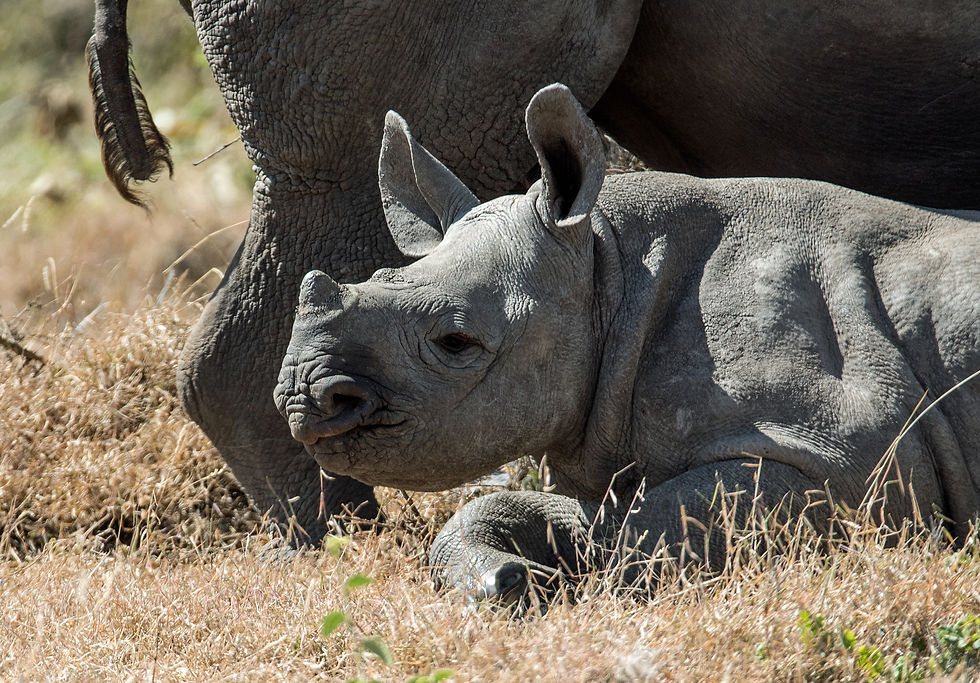
The Black Rhinoceros (Diceros bicornis) is one of Africa’s most remarkable large mammals, powerful in build, highly specialized in behaviour, and yet deeply vulnerable. Once roaming much of sub‑Saharan Africa, their numbers collapsed dramatically over the past century. Today, they stand as a potent symbol of both the fragility and resilience of African wildlife.
As Kruger Conservation continues its mission to support long‑term wildlife protection, we are actively raising funds to make a Black Rhino reintroduction project possible, a critical step toward securing the future of this endangered species.

Black Rhino vs. White Rhino — What Sets Them Apart?
Although their names might hint at different colors, Black and White Rhinos differ primarily in their ecological adaptations, not in pigmentation:
Feeding adaptation: Black Rhinos have a hooked, prehensile upper lip: ideal for browsing leaves, shrubs, and branches. In contrast, White Rhinos have a broad, flat lip, suited for grazing in open grasslands. (International Rhino Foundation ; National Geographic)
Diet and habitat: Black Rhinos browse woody vegetation and prefer dense bushland or woodland; White Rhinos graze grasses and favor open savanna.
Body build: Black Rhinos are generally smaller and more agile: about 1.4–1.7 m at the shoulder, 800–1,350 kg in weight and suited for maneuvering through dense vegetation. White Rhinos are larger and heavier, built for grazing over wide open plains. (International Rhino Foundation ;Encyclopaedia Britannica)
Social behaviour: Black Rhinos tend to be solitary and territorial; White Rhinos are more social, often forming small groups, patterns that align with their different habitats and lifestyles.
These contrasts illustrate how each species fills a distinct ecological niche. As browsers, Black Rhinos help shape vegetation structure, influencing the balance between woody plants and open areas, a subtle but important contribution to the structure and diversity of the bushveld ecosystem.

Population Status — A Species on the Edge
The history of the Black Rhino is one of dramatic decline, but also of cautious hope. At the start of the 20th century, it’s believed there were well over 100,000 individuals across Africa. Over decades of relentless poaching and habitat destruction, numbers plunged. By the mid‑1990s only about 2,300 rhinos remained in the wild. International Rhino Foundation )
Thanks to decades of focused conservation: anti‑poaching, translocations and protected reserves, populations have slowly begun to recover. Recent estimates put the wild population at around 6,788 individuals, living across multiple African countries. (International Rhino Foundation)
Nevertheless, the species remains Critically Endangered. The path to recovery is fragile, and the threats remain real.
Risks Remain — Why We Must Act Now
Despite conservation progress, Black Rhinos continue to face serious and ongoing threats:
Poaching and illegal horn trade remain among the most urgent dangers. Demand for rhino horn sustains illegal activity, pushing surviving populations closer to extinction.
Habitat loss and land‑use change: including expansion of agriculture, human settlements, and infrastructure, persistently reduce and fragment the natural habitats Black Rhinos depend on.
Population fragmentation and isolation hinder genetic exchange and long‑term species resilience, a risk that increases if remnant populations stay small and disconnected.
Because of these combined pressures, continued efforts in protection, habitat management, careful monitoring, and sustainable funding remain absolutely essential to ensure a future for the Black Rhino.
Gaps in Knowledge — The Need for Further Research
While we have solid data on population trends, threats, and basic biology, many questions remain open, especially concerning the broader ecological impact of Black Rhinos. The extent to which they influence vegetation structure, ecosystem dynamics, or biodiversity has not been comprehensively studied across their full range. Moreover, detailed research on genetic diversity, population connectivity, and long‑term effects of habitat fragmentation is limited.
Filling these gaps is crucial. Improved understanding will enable more effective conservation strategies, optimized reintroduction efforts, and a chance to restore ecological roles, not just to save individual animals, but to preserve living, functioning ecosystems.
Supporting the Future of the Black Rhino
Protecting this iconic species is a shared responsibility, one that demands collaboration, expertise, and sustained support from conservation organizations, institutional partners, and concerned individuals around the world.
By supporting initiatives such as Kruger Conservation’s Black Rhino reintroduction project , alongside respected partners like the International Rhino Foundation, community‑based wildlife agencies, and protected area authorities, you help to:
Strengthen and expand wild Black Rhino populations
Enhance genetic diversity through managed reintroduction and habitat restoration
Re‑establish rhinos in habitats where they once thrived
Support long‑term habitat management, anti‑poaching patrols, and monitoring
Even modest contributions matter. They help sustain the momentum of conservation, safeguard ecosystems, and preserve the heritage of Africa’s wilderness for future generations.
A Future Worth Fighting For
The Black Rhino’s story shows us that, even after severe decline, recovery is possible, when people commit to action, science, and collaboration. By supporting conservation efforts today, we help ensure that future generations may still witness these majestic animals roaming free, not just see them in pictures.
The Black Rhino belongs to Africa’s natural heritage and it deserves a future.
Comments